imgstyle: One Field Switching Four Art Styles
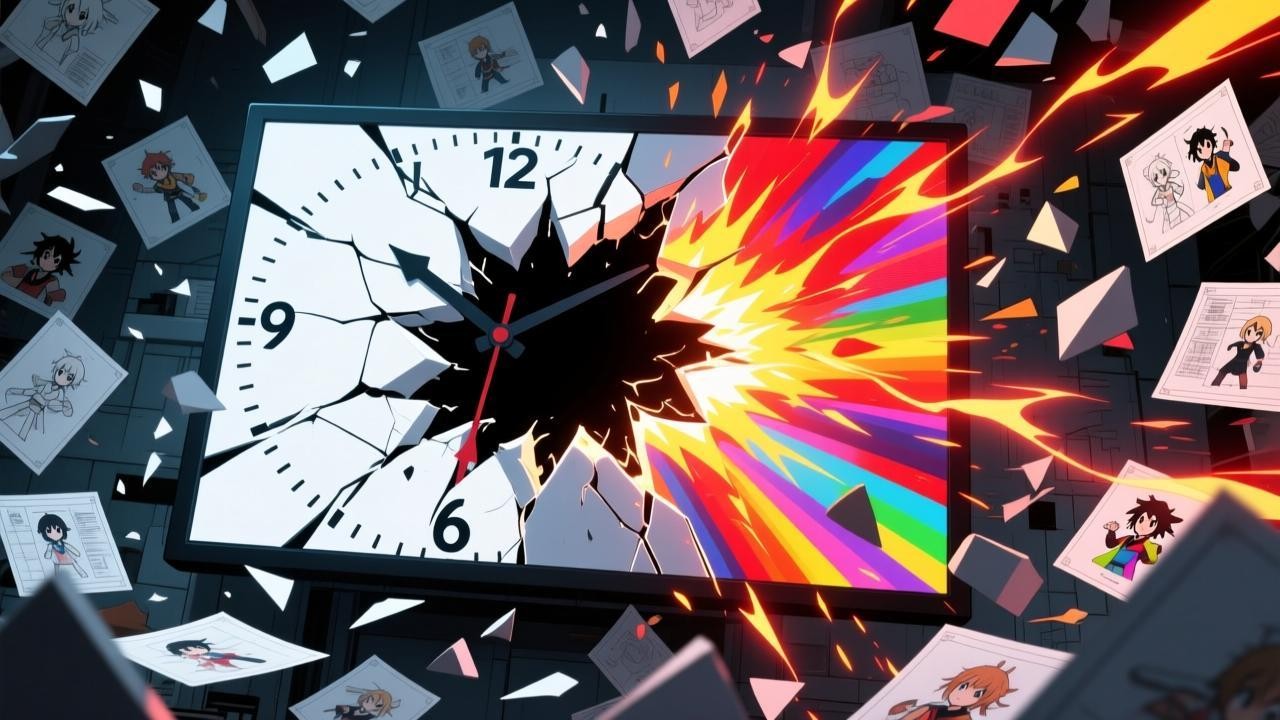
Style consistency is one of the most stubborn challenges in filmmaking. In traditional animated films, to ensure that a character looks like the same person across hundreds of shots, character design teams must draft unified standard sheets that animators then check frame by frame—any new team member needs days to absorb these art specifications. In AI video generation, this problem is amplified infinitely, because every time a large model is invoked to generate an image, without strict constraints, the model improvises freely: the same character may appear with a realistic face in one shot and suddenly shift to an anime style in the next. Such drift might be tolerable for a short film, but for a finished two-hour-and-twenty-minute *First Avenue*, spanning 1,029 shots across four chapters, style drift means the entire film falls apart. The CloudKude system solves this problem with a single field, `imgstyle`, which has only four values: `xs` for realistic, `gz` for period costume, `dm` for anime, and `xd` for modern. It is carried down from the article-chapter level by the `article.atctype` field. Once a chapter is assigned a specific style, all characters, locations, and scenes under that chapter automatically inherit the style marker, and the system writes `imgstyle` into the generation parameters every time it produces an image, forcing the model to output visuals matching that tone. This is a design that settles everything with one stroke: it moves style control from the artist's realm of inspiration down to a database field.
Why does traditional manual retouching lose to field switching in style unification? The core is the efficiency gap. When you need to retouch a hundred shots to the same realistic tone, you must adjust color levels, saturation, and sharpening one by one in post-production software, then layer on a unified filter. A skilled retoucher can handle at most thirty images a day; for a film with over a thousand shots, that means at least thirty days, not counting rework after revisions. In contrast, each row in `dbvideo_process` stores an `imgstyle` field. When `article.atctype` is set to `gz`, the system automatically reads that value and, when generating process prompts and image tasks, replaces style keywords in the language description with period-costume vocabulary—for example, swapping "glass curtain walls of a modern city" for "stone column plinths of an ancient palace." The model then instinctively adopts ink-wash and traditional color language during generation. The entire operation requires changing one field, clicking apply once, and all not-yet-generated storyboards automatically use the new style in subsequent tasks. For already-generated storyboards, the situation is far from helpless: just reset the storyboard's status to pending, and the system regenerates the image with the new style. The overall time cost depends on image generation speed, not manual retouching speed.

In the actual production of *First Avenue*, the power of this field-based control is fully demonstrated. The source novel is divided into four chapters. The system configures the "Five Elements Dragon Flag" chapter with the `gz` period-costume style, the "Miao Ba Zi Super Body" chapter with `dm` anime, the "Miao Bagua Super Body" chapter with `xd` modern, and the "Jia Bu Yi Super Body" chapter with `xs` realistic. This means that within a single film, viewers see four completely different visual systems presented alternately. The protagonist is played by different styles across chapters, but this switching is not arbitrary—it is locked in advance by fields. When each storyboard is generated, the system reads the `atctype` of the chapter to which that storyboard belongs, maps it to an `imgstyle` value, and ultimately writes it into the generation call. Imagine: the protagonist in the "Jia Bu Yi Super Body" chapter, wearing a realistic suit in a courtroom debate, and then in the "Five Elements Dragon Flag" chapter, the same character switches to a period robe, reviewing troops on the battlefield. Such a dramatic span in traditional films requires two complete art teams, two sets of costumes and props, and two post-production color schemes—but in the CloudKude system, it is merely a change in one field value.
`imgstyle` does not only control the overall look of generated images; it also acts simultaneously across three different image-generation paths. Character images go through `drawrole` with direct Volcano sync calls: when the system reads the appearance description from the character table, it appends style prompts corresponding to `imgstyle` on the fly—for example, the realistic style appends "real skin texture, natural lighting, no illustration traces" to the description, while the anime style appends "bright flat colors, exaggerated expressions, fine linework." Locations go through the empty-rolex branch of `placeaiwords`: during pure text-to-image, the text read from the location table is likewise injected with style words—period-costume location descriptions emphasize ancient architectural elements such as flying eaves, bracket sets, and gray brick paving. Scenes go through the with-character branch of `placeaiwords` plus `scenetopic` image-to-image synthesis. At this step, `imgstyle` is irreplaceable: it determines how the character image and location image achieve style matching during synthesis. If the character image is anime while the location image—for whatever reason—was generated in a realistic style, the composite result will show obvious tearing. But because the `imgstyle` field is propagated uniformly across all three paths, the system guarantees that the character image, location image, and scene image all originate from the same style constraint, thereby preventing such conflicts. In the actual scene synthesis of *First Avenue*, the "Miao Ba Zi Super Body" chapter belongs to the anime style; the character images and location images in that chapter are all drawn in bright, saturated flat coloring. During synthesis, the system checks that `imgstyle` matches before allowing the overlay; otherwise, it blocks task submission. This mechanically severs any possibility of style mixing. The four chapters each present unified style segments, giving the whole film high internal coherence amid overall diversity.
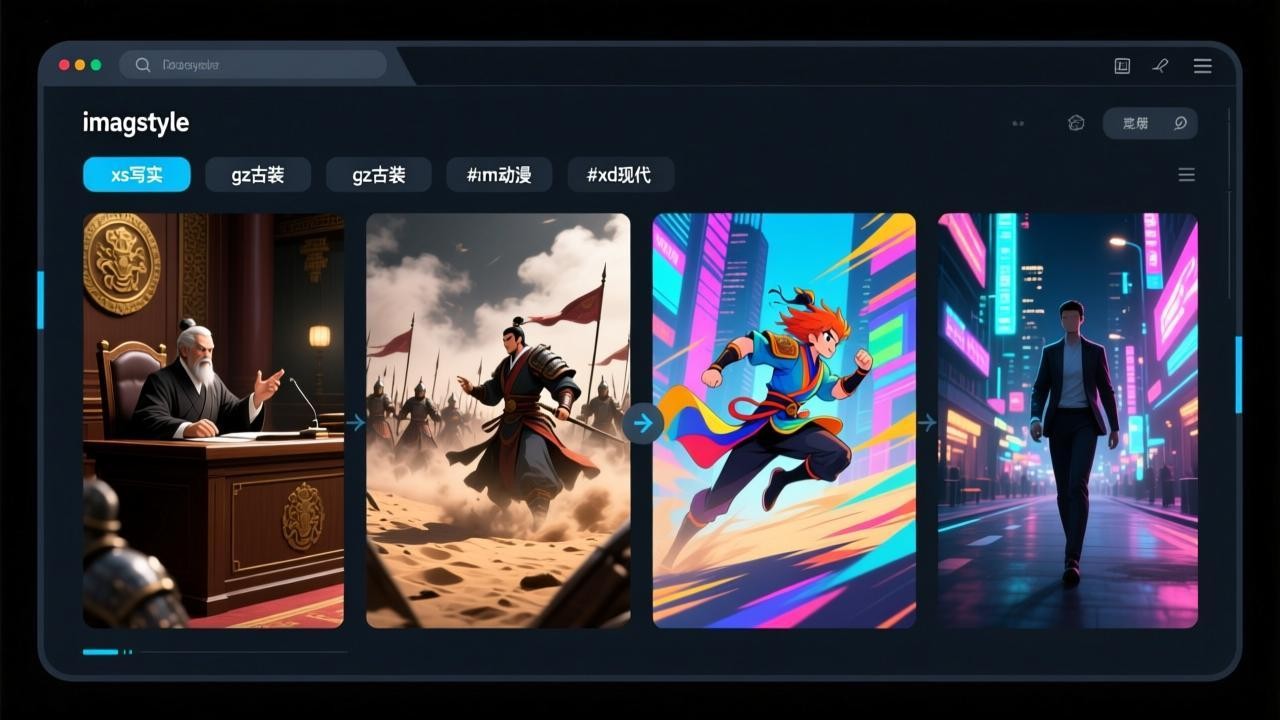
This coherence does not depend on the patience of post-production colorists comparing frame by frame—it relies on a standardized field in the database. Across the more than one hundred shots in the "Five Elements Dragon Flag" chapter, the dominant color, line weight, and lighting logic remain highly consistent, because every image task reads the same `imgstyle = gz` tag. All shots in the "Miao Ba Zi Super Body" chapter retain anime's exaggerated contours and brightness; the modernity of the "Miao Bagua Super Body" chapter emerges through glass and geometric elements within its scene design; the realistic texture of the "Jia Bu Yi Super Body" chapter comes from fine surface details and physically accurate lighting. If, one day, a producer demands that the "Five Elements Dragon Flag" chapter switch from period costume to realistic, then `atctype` for that chapter in `xctoscene` is changed to `xs`, and all storyboards not yet generated—or generated but reset in status—automatically regenerate in the realistic style. The construction time equals only the image generation time, with zero manual repair cost. In traditional filmmaking, this corresponds to reshooting an entire chapter or re-rendering an entire VFX sequence—a change capable of sinking a project's budget. Under field control, it becomes a trivial status change.
For a solo creator, the significance of metadata-driven style control lies not only in efficiency but in enabling one person to manage, in an engineering manner, the visual diversity that would otherwise require an art team. If every image required hand-written complex style descriptions, then facing 1,029 shots, no matter how diligent, one person could not finish generating and adjusting all images within eleven days, because the writing alone is a massive physical burden. The `imgstyle` field extracts style information out of the semantic layer of prompts, turning it into an enumerable, overridable, batch-replaceable value. It no longer requires the model to understand what a style is—only that the system translates it into short phrases the model can read when assembling prompts. By modifying `article.atctype` in one go, an entire chapter's shots can all be reclothed. This capability fundamentally changes the granularity of visual control in filmmaking. From now on, style is no longer scattered lines or filters—it is a database field, stably occupying a column in every row of `dbvideo_process`. It no longer depends on human inspiration but on system determinism. And it is precisely this determinism that allows a configuration of one person and three computers to produce a feature-length film with four distinct visual styles and enormous stylistic range.