Scene Equals Character Plus Location: AI Film's Smallest Unit Is an Addition
If I could keep only one sentence from this entire film, it would be this:
**Scene = Character + Location.**
That's not a metaphor. It's literal. A qualified cinematic frame is synthesized from one portrait plus one landscape.
**Why can't you do it in one step?**
Beginners always do this: write a long prompt—"a middle-aged man in a long gown standing in a Republican-era print shop, warm yellow lighting, film grain"—and throw it at the model.
What comes out? The person is right, and the factory is right, but something's always off: the person looks pasted on, perspective is wrong, lighting is inconsistent, no shadow under the feet.
The reason is simple: **You're asking the model to solve two problems at once**—what this person looks like, and what this place looks like. It has to guess on both sides, so both sides come out wrong.
The correct approach is to split it apart: the person only solves the person, the place only solves the place, and then you composite them.
**After splitting, two images decide everything.**
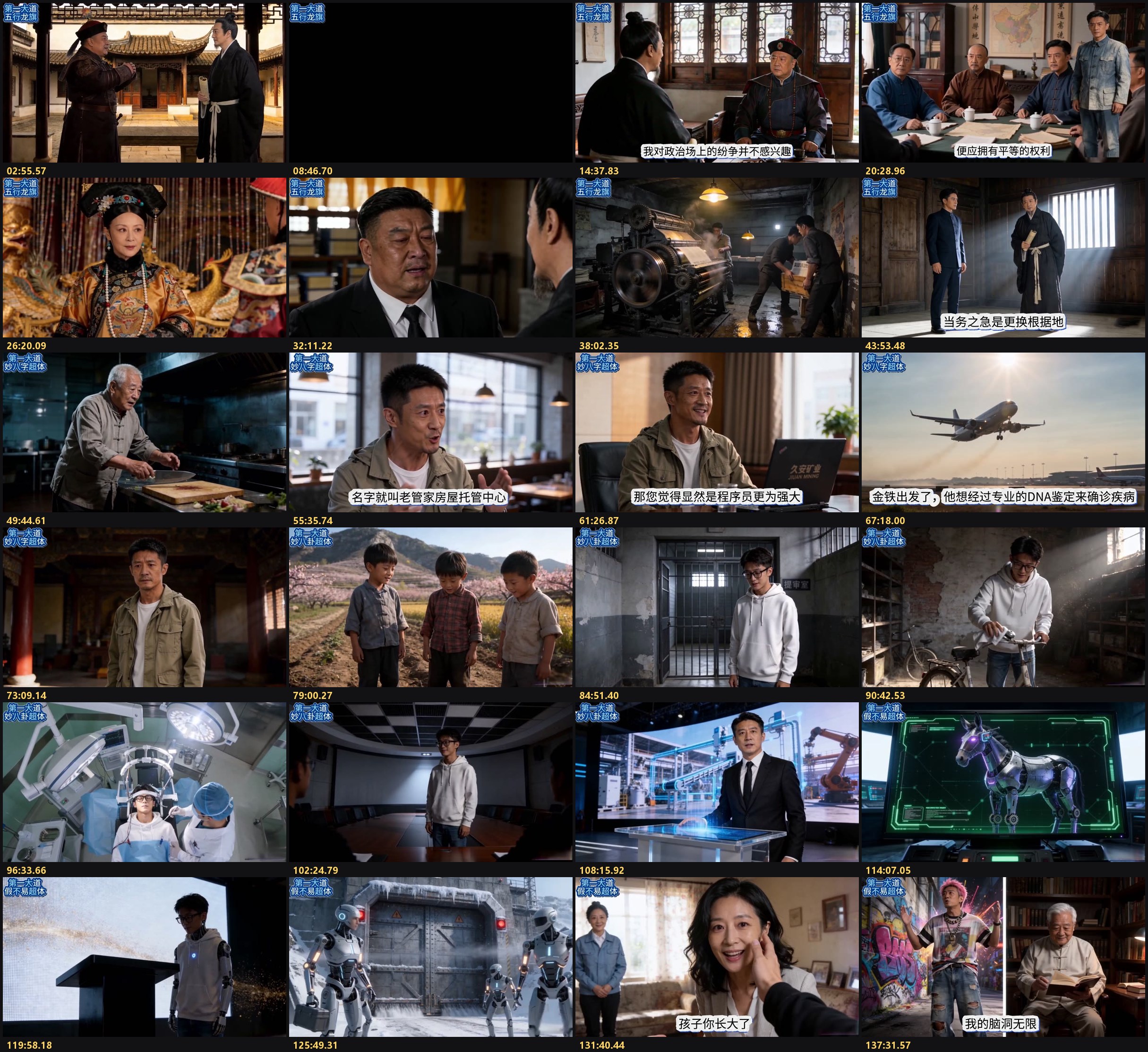
**Character image.** All 224 characters in the film—each one gets a character sheet first. That single image fixes this person's appearance in every shot afterward: face shape, hairstyle, age, costume baseline.
**Location image.** All 1,009 scene rows—each one gets an empty establishing shot first. An empty factory with no people, an empty living room with no people, an empty exterior of the Yueyang Tower. That image fixes lighting, color tone, and spatial relationships.
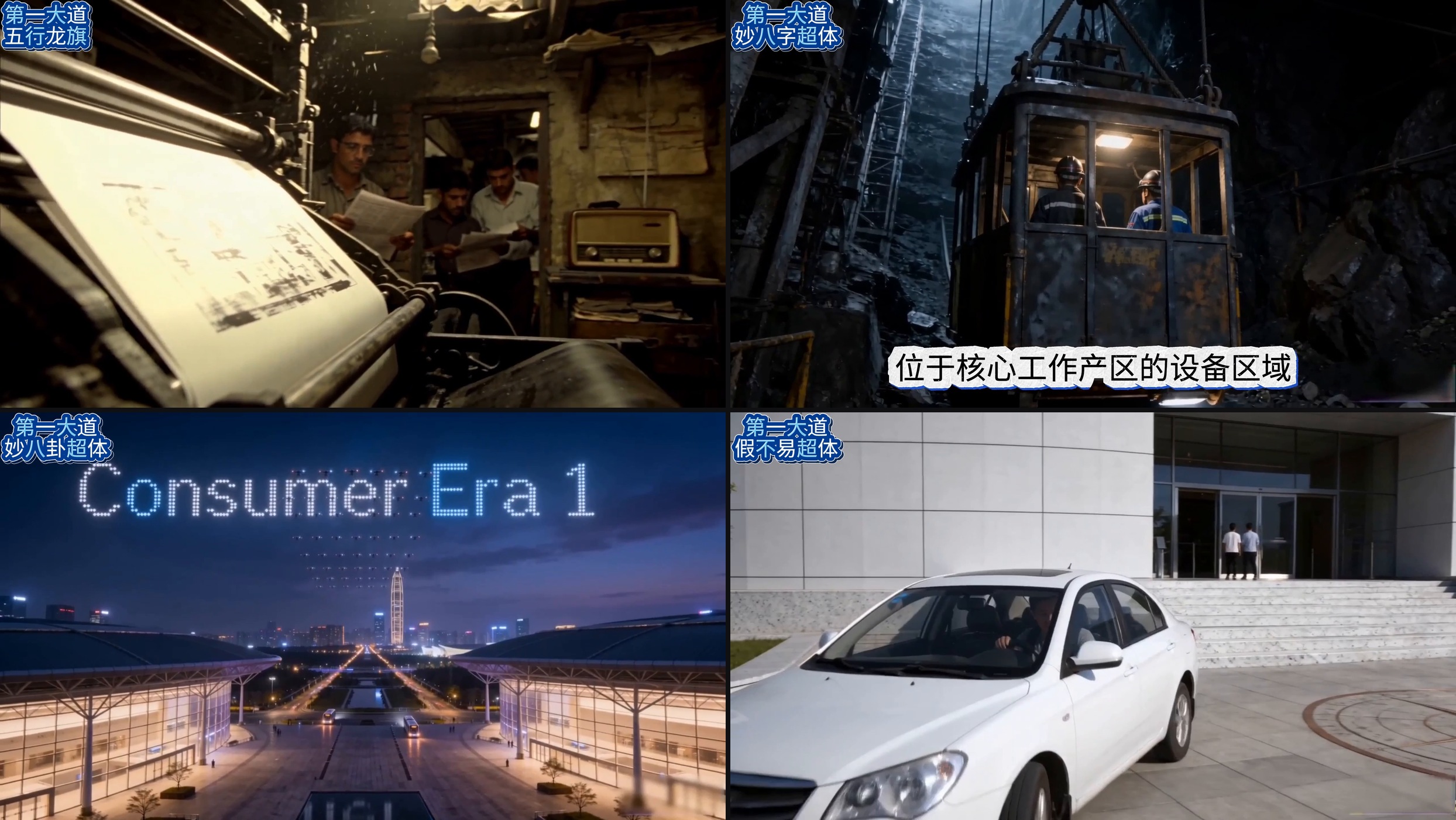
Once both images are right, compositing becomes meaningful.
**And in that compositing step, the prompt is just the positions of two images:** one is the person, one is the scene—everything else is fixed boilerplate: cinematic lighting, premium texture, plausible perspective, balanced proportions, sharp details, full atmosphere, natural and unforced.
The first time I saw that compositing prompt in the system, I froze for a few seconds. Because it was written too plainly:
> Composite the person from (character image) into the scene from (scene image).
That's the addition, in black and white.
**The data layer is addition too.**
The image layer is addition, and so is the data layer.
In the storyboard table, every shot row stores two things: who is in this shot (character names, comma-separated) and where this shot takes place (a short code pointing to the scene table).
Remove those two columns, and the row is left with only dialogue and shot number. It's still a record—but it's no longer a shot.
So I say: **Storyboard = Character + Location.**
These two formulas may look like tautologies, but they operate on two different levels: one says how the image is produced, the other says how the data is produced. **Miss either layer, and you won't be able to finish.**
**Why this insight is valuable**
Because it's the source of replaceability.
Keeping characters in their own table means swapping an actor only requires changing one row. If you run two hundred shots with look A early on, then decide later it doesn't work and want a different face—edit that one character row, re-composite, and you don't need to re-slice storyboards or rewrite prompts.
Keeping locations in their own table means swapping a location works the same way.
And because a storyboard is just a combined row of the two, it means **shots can be reordered arbitrarily**. You can even move a scene from Act Three into Act One—just change the shot order.
That's the difference between craft and engineering: with craft, a change means redoing the work; with engineering, a change means updating one record.
**A counterintuitive detail**
In the scene table, the row count nearly equals the storyboard count—1,009 rows versus 1,029 shots.
Many people's first reaction: aren't these two tables redundant?
No. Because **the same location appears as two different rows in two different shots**. The living room is daytime in one scene and nighttime in the next; one person sits in the living room, then another stands there. Different lighting, different composition, different characters—those are two different scenes.
So the scene table isn't a "location dictionary"; it's a "shot-level scene list." If you want to count how many distinct places the film has, you have to deduplicate by location name—you can't just count rows. I got this wrong myself at first.
**The order of the addition can't be reversed**
One final point about sequence: **character first, then location, then composite.**
If the character isn't fixed, every face you composite will look different. If the location isn't fixed, every space you composite won't match across shots. And if neither is fixed before you composite, you'll get two hundred illustrations in different styles—not a film.
This sequence is something I only accepted after stepping on the rake. Next post: how the 1,029 shots were actually cut.