Three Prompt Templates Cover Three Paths for 1,000+ Shots
Three prompt templates cover a complete AI film generation pipeline. In the CloudKude system, any film—from storyboard to finished cut—necessarily passes through three stages: using `process.aiwords` to drive Jimeng in generating eight-segment skeletal video prompts, using `places.aiwords` to execute pure text-to-image for locations and image-to-image synthesis for scenes, and using `arcpictask.taskdes` to control first-frame and last-frame image detail. These three templates each govern their own segment, never overlapping, yet chained together, forming a structured system that manual per-shot prompt writing could never match. The 1,029 shots of *First Avenue* were generated under the coordination of these three templates. The finished cut—over two hours, two hours and twenty minutes—has an audio proportion of 87.2%, a resolution of 2560x1440, and a bitrate of 7.7Mbps. These hard metrics are not a matter of luck; they are directly guaranteed by the determinism of the prompt templates. Understanding the differences between the three templates, their applicable boundaries, and the engineering significance of their fixation is the only way to truly grasp why prompt engineering occupies the position of core infrastructure in AI film production.
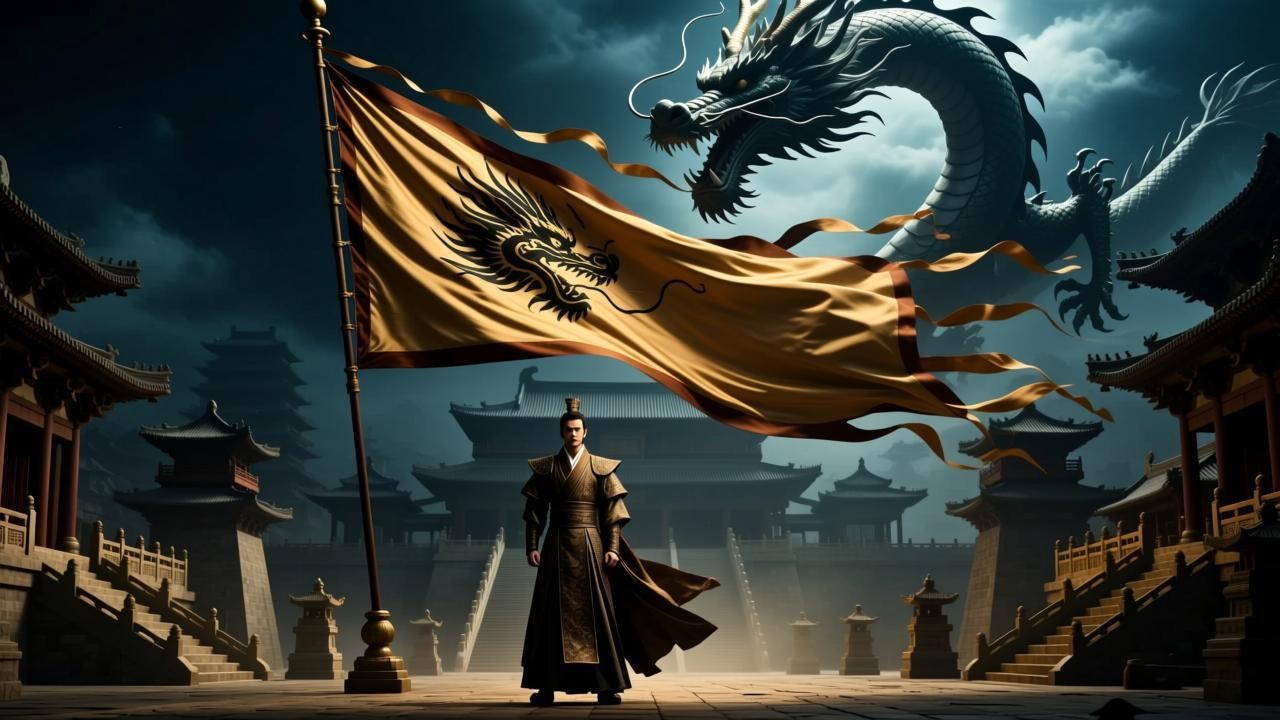
The first template is `process.aiwords`. It is the most complex template in the entire generation flow, bearing the responsibility of generating Jimeng video prompts for every storyboard. Its special feature is a fixed eight-segment skeletal structure: character information, lip-sync consistency, accent and tone, shooting technique, scene location, frame action, aspect ratio, clarity, and duration. Each of the eight segments has its own clear grammatical rules and vocabulary constraints, requiring almost no creativity from the generator. In a certain shot of *First Avenue*—for example, depicting the protagonist standing beneath a dragon banner—`process.aiwords` organizes content as follows: the character information segment fills in the character's appearance features, attire, and identity tags; the lip-sync consistency segment writes in the audio source identifier corresponding to that character to ensure mouth-sync during speech; the accent and tone segment fills in a calm or urgent expression style based on the character's profile; the shooting technique segment specifies a push-in close-up or pull-back wide shot; the scene location segment references the location description corresponding to that storyboard; the frame action segment fills in specific body movements and facial expressions; the aspect ratio is fixed at 16:9 corresponding to 2560x1440; clarity and duration are locked to 4K quality and a duration of several seconds. Once generated, this prompt is submitted as the final video generation instruction to the Jimeng platform, whose video model takes the eight-segment skeleton as input and outputs a video of continuous motion. Its variable components number only three: character information, scene location, and frame action. The remaining five segments are all fixed values read directly from global configuration and storyboard attributes. This extreme fixation ensures that style parameters remain completely consistent across shots, with no fluctuation caused by the prompt writer's mood at any given moment.
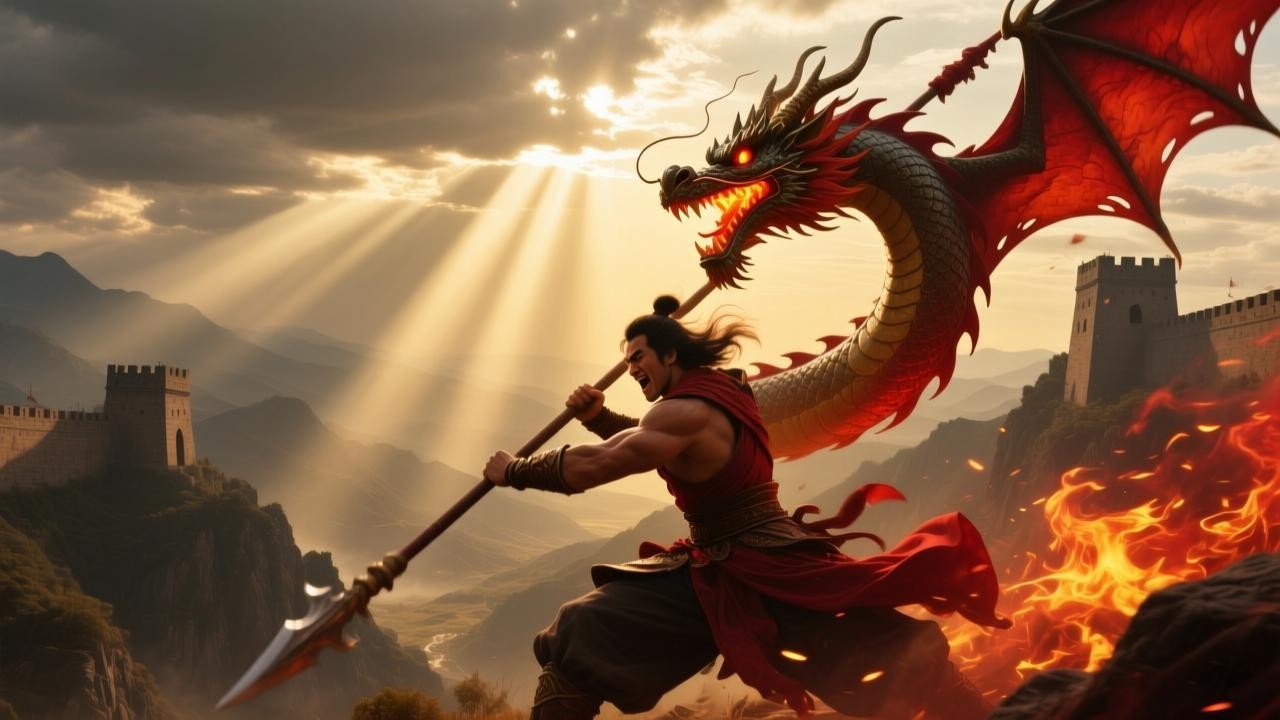
What do three variable points mean? It means that in normal production flow, there is no need for creative prompt conception per shot—you only need to extract three definite values from the database. Taking the "Five Elements Dragon Flag" chapter as an example, more than a hundred shots share the same protagonist and the same location, so character information and scene location are nearly invariant; the only thing that needs to change is the frame action. When generating the shot "protagonist waves the banner and shouts," the frame action fills in "right hand raises the dragon banner high and waves it toward the sky, shouting a command that echoes through the valley," while the other seven segments directly reuse the previous shot's template parameters. This extreme fixation is decisive for engineering efficiency: it reduces the video-prompt generation time for 1,029 shots from more than ten days of manual writing to less than half a day, because each shot's prompt entry is essentially an automatic fill of the template rather than writing a new piece of copy from scratch. Manual prompt writing means each shot requires the author to understand the plot, judge the visual style, and select wording; template-based filling means only three fields need replacing, with everything else assembled by the system according to fixed logic. Comparing the two, the difference in efficiency and consistency spans an order of magnitude.
The second template is `places.aiwords`. Its core duty is generating composition prompts that drive two different image-generation paths. When a storyboard contains only a location with no character, it corresponds to the pure text-to-image branch. The system invokes the empty-rolex branch of `places.aiwords`, converting the location description into a prompt pointing to a characterless image—for example, "In the center of an empty valley stands a tattered dragon banner, its surface flapping as the wind passes; surrounding it are scorched battlefield relics, cold color tone, high detail, realistic style." When a storyboard contains both a character and a location, the with-character branch is triggered. This branch introduces the @-reference mechanism on top of `places.aiwords`. The so-called @-reference means explicitly citing a completed character image as the base within the prompt, then overlaying the location's scene description, thereby synthesizing a complete scene image of "that character standing in that location." In one shot of *First Avenue*, with the protagonist standing at the center of the Bagua array, the system takes the description from that location's row in `dbvideo_places`, then references the protagonist's portrait in `dbvideo_roles` via the @ mechanism. The two form a spatial relationship in the composition prompt, ultimately generating a scene image containing both the character and the environment. This scene image subsequently serves as the first or last frame of the shot, with its details controlled by `arcpictask.taskdes`. The beauty of this template is that it does not require generating new text; it concatenates an existing character image with an existing location description into a contextualized entity. Since `placeaiwords` is configured in the database as one row per shot, each storyboard has its own location description entry, so no matter which generation path is switched to, the system can promptly retrieve the corresponding prompt from that storyboard's places record without template conflicts or missing references. Writing such composition prompts manually requires simultaneously considering the relationship between character and location—spatial composition, lighting direction, perspective angles—which is extremely difficult. After templating, all that's needed is connecting the character image path and the location prompt with an @ symbol, supplemented by the global style switch `imgstyle`, to obtain reproducible results.
The third template is `arcpictask.taskdes`. It is responsible for the detail of first-frame and last-frame image generation. Each shot must produce two images: the first frame with an `-a` suffix and the last frame with a `-b` suffix. These two images serve as the starting and ending points for image-to-video generation. The content of the `arcpictask.taskdes` template does not include a complete scene description; rather, it focuses on composition optimization details within a single frame—such as subject position, negative space, focal area, depth of field, and color tone. In the "Miao Ba Zi Super Body" chapter of *First Avenue*, a certain shot's first frame requires the character to be positioned at the left third of the frame, gaze directed rightward, background blurred, with focus concentrated on the character's face; the last frame requires the character to have moved to the right side of the frame, turning back to look, with the background in sharp focus and an evening atmosphere over the entire frame. After these two images are generated separately, the Jimeng video model automatically interpolates the intermediate motion based on the difference between the first and last frames, generating a video of continuous action. The stability of `arcpictask.taskdes` directly determines video quality—if the style difference between the last frame and the first frame is too large, the model generates aberrant transitions. Therefore, this template is designed to be tightly coupled with fields in `dbvideo_process`: when generating each shot's first and last frames, the system reads both that shot's `places.aiwords` and `arcpictask.taskdes` simultaneously, ensuring the location prompt and the frame-description prompt describe the same spatial scene. In the practical execution of *First Avenue*, paired generation of first and last frames is mandatory. The system includes a validation mechanism that refuses to submit a video generation task once a missing last frame is detected, preventing the generation of gray placeholder images. This template is even more firmly fixed than `process.aiwords`—it doesn't even need three variable points, because the first and last frames' composition parameters often reuse the same shot's preset, only automatically switching style parameters based on scene type.
The coordination among the three templates can be summarized as a pipeline: first, read the storyboard record from the database; use `places.aiwords` to generate a scene image or a pure-location image; then combine it with the character image via the @ mechanism to synthesize a scene image with characters; next, feed this synthesized image as the first frame into `arcpictask.taskdes` to generate the shot's first and last frames; finally, submit the first and last frames together with the eight-segment prompt generated by `process.aiwords` to the Jimeng platform, completing the leap from image to video. Throughout this entire flow, the role of manual prompt writing is compressed to the minimum—the system's template-filling commands automatically complete the vast majority of text work. Imagine: if a human hand-wrote the first-frame, last-frame, and video prompts for all 1,029 shots, each shot would require conceiving hundreds of characters of precise description. A skilled prompt engineer working at full capacity could complete only thirty to fifty shots per day; the entire project would require more than twenty days, with no guarantee of stylistic consistency between batches. With template-based automated generation, three computers in eleven days not only completed video generation for all shots but also completed every other stage—character image generation, location image generation, scene synthesis, and first/last frame generation—finally delivering a finished cut of two hours and twenty minutes. The root of this efficiency gap lies not in the writer's literary talent, but in solidifying the monotonous eight-segment skeleton and composition rules into template code, allowing a person to provide only three key variables while the system assembles the rest. This design does not pursue artistry in prompts; it pursues determinism and repeatability in the engineering sense. And it is precisely this determinism that allows one person, using three computers in a resource-constrained environment, to complete an AI film that would conventionally require a professional team and a timeline of months.