Title First, Then Structure, Then Storyboard: Six Steps from Novel to Film
Making an AI film—in the end, I only remembered three sentences.
**Title first, then structure, then storyboard.**
In classical terms: **One gives birth to two, two gives birth to three, three gives birth to all things.**
This isn't mysticism. It's the construction order I distilled after pushing a 90,000-character novel into a two-hour-and-twenty-minute film. Get the order right, and every step produces something usable; get it wrong, and you'll get lost in a pile of raw material.
**I. Establishing the title: give the film a root first.**
The first step isn't writing a script—it's "establishing the title."
In my system, that means creating a bibliographic record: book title, author, and a short code. For *First Avenue*, the code is four letters.
This step looks like it does nothing, but it actually defines the naming space for the entire film. Every table downstream—characters, locations, storyboards, image-generation tasks—relies on this short code to recognize its family. Without it, your material is just loose sand.
**Establishing the title is the "one" in "one gives birth to two."** A single name is the root node of the whole universe.
**II. Forming the body: recording the text chapter by chapter.**
The second step is entering the novel's body text into the "article table," chapter by chapter.
Each record must carry four things: which book it belongs to, that chapter's code, the body text itself, and the art style.
There's a detail here that trips many people up: the body text must be encoded before entering the database, and **each chapter can't be too long**. The database's text field has a limit; exceeding it won't throw an error—it silently truncates. The result is that your storyboard comes up one plot segment short, and you never know which one's missing.
My book ended up with 69 chapters, each around 2,000 to 3,000 characters—just right.
**This is "two": from one book title, a "body" is born—a novel with chapters, body text, and encoding.**
**III. Slicing into shots: cutting each chapter into storyboard shots, one by one.**
The third step is the blade of the entire pipeline.
For each article, run one "text-to-storyboard" pass. The system treats the large model as a "senior director and screenwriter," having it cut the chapter into a number of shots, each shot providing five things:
Which shot number, what camera technique is used, what this location is called, how this location should be depicted, and who is in this shot, saying what line or doing what action.
The results land in three tables simultaneously: **characters go into the character table, locations go into the scene table, and shots go into the storyboard table.**
**This is "three": when people and places collide, a third thing is born—the shot. It is neither a person nor a place; it is the encounter between the two.**
There's a trap to flag here: this function has an idempotency lock. If a chapter has already been sliced into storyboards, it will refuse to run, returning "Storyboard already exists." To re-slice, you must first delete that chapter's storyboard entries—otherwise, you'll think the function is broken.
**IV. Generating images: turning text into pictures.**
The fourth step is generating an image-generation task for every row in the scene table.
Each shot needs two images: a first frame and a last frame. So 1,029 shots means 2,022 image-generation tasks.
I'll explain the specifics later—characters, locations, and scenes take three different paths, and if you get the order wrong, the whole film is wasted.
**This is where "three gives birth to all things" begins: one shot starts generating images.**
**V. Writing back: images must return to the tables.**
The fifth step is the easiest to overlook and the most critical.
Once an image is generated, it must be written back into the tables: the scene image goes back to the scene table, the first frame goes into the storyboard table's first-frame field, and the last frame goes into the last-frame field.
What happens if you don't write back? The images exist only on the machine, but the tables are empty. The next day, when you want to continue—or when you hand off to another computer—you'll find "I definitely generated this," but nothing exists in the system.
**This step turns "work" into "assets."**
**VI. Assembling the final cut: into the video model, then stitched together.**
The last step is what most people think "AI film" means.
Take the first frame and last frame, add the video prompt for that shot, and feed them into the video model to generate a five-to-six-second clip. Once all clips are generated, arrange them by chapter and shot order, stitch them together, add audio, and add subtitles.
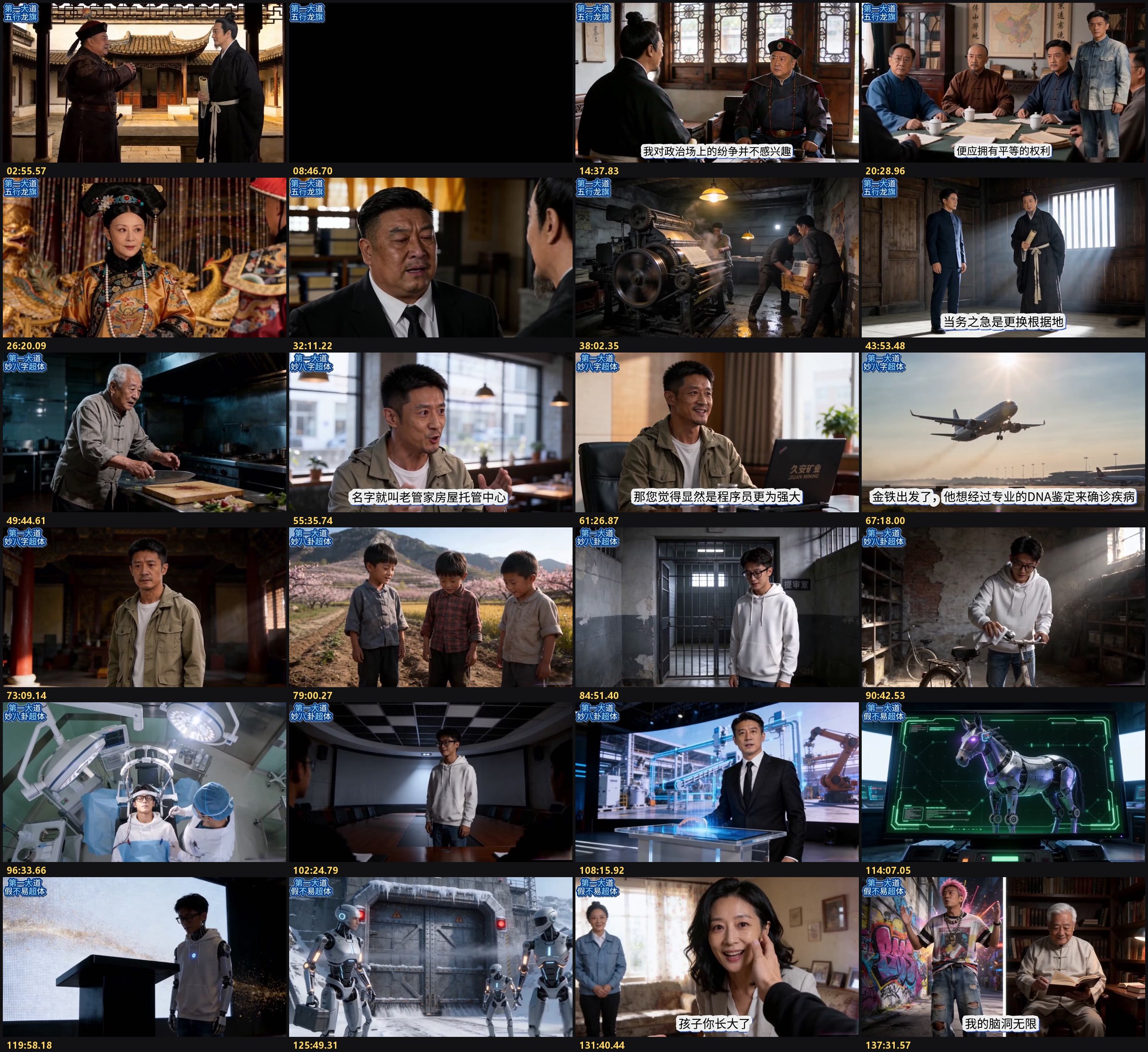
At this point, a book becomes two hours and twenty minutes.
**Why the order can't be changed.**
I've seen too many people ask right away: "What model do you use? How do you write the prompts?"
Models and prompts matter, of course, but they're third-level concerns. What actually determines whether you can finish a film is the first two levels: **Do you have a title? Do you have a body?**
Without a title, your 1,000 shots are orphans. Without a body, your storyboards have no source—change one line of dialogue and you won't even know where to change it.
Title first, then structure, then storyboard. Once those three steps are done, everything else is just grunt work.
Next post, I'll cover the most critical addition: **scene equals character plus location.**